Showing posts with label Argentine memories. Show all posts

Monday, June 13, 2011

Sugus

(En español más abajo)
 
CanadaThis could be perceived as a chauvinistic statement, but I have to say it: I think Argentine candy and chocolates are the best in the world. Having travelled a little, and having tried many different kinds and brands, I have little doubt in my mind that nobody produces candy like my fellow Argentines.
 
I know that would be a totally subjective and imprecise comment (having been to about 10 of the 200+ countries in the world), but that is my story and I will stick to it. Contrary to what you might think, I’m not that crazy about chocolates; candies, however, and especially chewable candies are one of my many weaknesses. Though I prefer other Argentine brands (and I always make sure I bring a 1Kg bag of those whenever I go back home), I will talk about my experience with the most recognized brand we have in Argentina: Sugus.
 
Sugus candies (‘caramelos’, in Spanish) are small, square and flat. You could think of them as ‘half a cube’ in terms of size and shape. They come in different flavours, and to my surprise, I discovered that the flavours vary as you go to different countries. In Argentina, the traditional flavours have always been: lemon, orange, pineapple, mint and raspberry. A new set of flavours were added with the years: grape, apricot and green apple. I don’t like any of the three. I believe they have also replaced raspberry with strawberry now.
 
There is a colour code for candies, at least in Argentina, and it’s normally respected by all brands: yellow for lemon, orange for orange (duh), blue (occasionally, purple) for pineapple, dark green for mint, light green for apple, purple for grape, light red for raspberry or strawberry, pink for tutti-frutti, dark red for cherry… the list goes on an on.
 
There was a time when Suchard (makers of Sugus back then) had raspberry, strawberry and cherry flavoured candies at the same time (let me tell you, the cherry ones were glorious). The problem is… they were all red! It was almost impossible to tell which one was which (cherry ones were a little more identifiable) until they were in your mouth.
 
As a kid, I would open one of each flavour (except mint) and put them all together in my mouth. It was a fruit extravaganza… I bet every kid has done that. Now I have become some sort of a gourmet, as I combine them in different ways: a lemon candy with a mint candy, for example, a combination I call ‘Roque Narvaja’ (a famous rock singer from Argentina) because of a song he wrote back in the 80’s called ‘Mint and lemon’.
 
IMG01447-20110515-2306
 
I have a vivid memory of having seen a bag containing ‘white’ Sugus once, but I’m not sure whether that is true or something I have imagined (plus, what flavour those would be?). I also remember having eaten candies with the paper wrapper and everything, after having been challenged by my cousin. They were… well, papery.
 
I always regretted that there were no banana-flavoured Sugus (banana being my second favourite flavour after cherry). It wasn’t until I found out that there were Sugus candies in other countries in the world (Mexico, Spain and Romania, for example) that I got to enjoy such a treat. A friend of Santi, from Romania, spotted a bag of candies at home one day and said: “Oh, Sugus! They’re from Romania”. “No, they’re not!”, I replied, “Sugus candies are from Argentina!”.
 
It turned out that we both were right. Cadbury had purchased the brand and was now commercializing them globally. Romanian Sugus candies are bigger, more chewy and they are mostly sold in three flavours: orange, grape and banana. Though I didn’t like their consistency, I really enjoyed the banana ones, as I said.
 
Sugus are one of the most recognized brands in Argentina, to the point of having almost become the generic name for chewable candies, like Curitas is for band aids and Gillette is for shaving blades. Everybody enjoys them, and everybody has a favourite colour.
 
Mine are green (mint), which are the only ones the kids leave after they’ve been looting my stash. Do you know Sugus candies? Which ones are your favourites?
 
 
ArgentinaTal vez vean esto como un ataque de chauvinismo, pero debo decirlo: creo que el chocolate y las golosinas de Argentina son las mejores del mundo. He viajado un poco, y he probado distintas clases y marcas, y es por eso que tengo pocas dudas de que nadie produce golosinas como mis compatriotas.

Sé muy bien lo subjetivo e impreciso que es mi comentario (siendo que sólo conozco unos 10 de los más de 200 países en el mundo), pero esa es mi historia y la voy a mantener. A diferencia de lo que puedan pensar, a mi los chocolates no me mueven un pelo; los caramelos, sin embargo, y especialmente los masticables, son una de mis muchas debilidades. Si bien prefiero otras marcas de Argentina (y siempre me aseguro de traerme una bolsa de 1Kg cuando viajo a casa), voy a contarles de mi experiencia con la marca más reconocida en Argentina: Sugus.

Los caramelos Sugus son pequeños, cuadrados y chatos. Se podría decir que son 'medio cubo' si tuviera que describirlos. Vienen en diferentes sabores, y para mi sorpresa, he descubierto que estos sabores varían de acuerdo a cada país en el que son producidos. En Argentina, los sabores tradicionales han siempre sido: limón, naranja, ananá (piña), menta y frambuesa. Un nuevo grupo de sabores fue agregado con los años: uva, damasco y manzana verde. No me gusta ninguno de los tres. También creo que han reemplazado a la frambuesa por la más tradicional frutilla (fresa).

Hay un código de colores para los caramelos, al menos en Argentina, y es respetado por la mayoría de las marcas: amarillo para el limón, naranja para la naranja (obvio), azul (y a veces violeta) para los de ananá, verde oscuro para la menta, verde claro para la manzana, violeta para los de uva, rojo claro para los de frutilla o frambuesa, rosa para el tuti frutti, rojo oscuro para los de cereza… y la lista sigue y sigue.

Hubo un tiempo en que Suchard (fabricantes de los Sugus por entonces) tenían caramelos de frambuesa, frutilla y cereza al mismo tiempo (y los de cereza eran espectaculares). El problema era que… eran todos rojos! Era prácticamente imposible determinar cuál era cuál (los de cereza eran un poquito más fáciles de identificar) hasta que estaban en tu boca.

De niño, solía abrir uno de cada sabor (excepto de menta) y me los zampaba todos juntos en la boca. Era una explosión de sabor… Muchos chicos lo hacían. Ahora me he convertido en un gourmet, ya que los combino de distintas maneras: por ejemplo uno de limón y uno de menta, una combinación que llamo 'Roque Narvaja', en homenaje al músico argentino del mismo nombre que escribió una exitosa canción en los '80s, llamada ‘Menta y limón’.


I got this picture from this Japanese site. Do they have Sugus too?
Saqué esta foto de este site japonés. También tienen Sugus allá?

Tengo una memoria muy vívida de haber visto una bolsa conteniendo Sugus blancos una vez, pero no estoy seguro de que haya sido algo que viví o algo que me imaginé (además, de qué gusto hubieran sido?). También recuerdo comer los caramelos con papel y todo, como respuesta a un desafío hecho por mi primo. Tenían gusto… bueno, a papel.

Siempre lamenté que no hubieran existido Sugus de banana (mi segundo gusto preferido luego de la cereza). No fue hasta que descubrí que habían Sugus en otros lugares del mundo (México, España y Rumania, por ejemplo) que pude disfrutarlos. Un amigo de Santi, rumano él, una vez vio una bolsita con unos Sugus que teníamos y dijo: “Oh, Sugus! Son de Rumania”. “No, nada que ver!”, repliqué, “los Sugus son de Argentina!”.
 
Resultó que los dos teníamos razón. Cadbury había comprado la marca y ahora los comercializa globalmente. Los Sugus rumanos son más grandes, más 'masticables'(si cabe el término) y si mi memoria no falla, se venden en sólo tres sabores: naranja, uva y banana. Si bien no me convenció mucho la consistencia, me encantaron los de banana, como dije.

Sugus es una de las márcas más reconocidas en Argentina, al punto de haberse convertido en una marca genérica para caramelos masticables, como Curitas lo es para los apósitos y Gillette para las hojas de afeitar. Todo el mundo los disfruta, y todos tienen un color favorito.

El gusto favorito mío es menta (los verdes), que son además los únicos que los vándalos dejan luego de haber saqueado mis pertenencias. Y ustedes, conocen los Sugus? Y en ese caso, cuáles son sus favoritos?

 
Technorati Tags: ,,

Wednesday, November 03, 2010

Curros, buscas and gestores

(En español más abajo)
 
CanadaI've been thinking about my trip back to Buenos Aires, almost a year ago, what with all the news coming from there lately (namely, the death of former President Néstor Kirchner). Then I realized I had taken notes while in there, with the idea of them becoming the subject of future posts. I took a LOT of notes, actually, but not all of them would make good posts. Come to think of it, I wonder if any of them do! :-)
 
I will start by bringing up two or three peculiar characters I observed while I was lining up to get my Argentine passport renewed (something that never happened, thanks to bureaucracy). As I had written back then, I arrived there in the early morning, but the place was already packed. In fact, the line to the Customer Service window was so long that it went all the way outside and then around the corner (two corners!). I estimated it was at least 250 m long (100 ft).
 
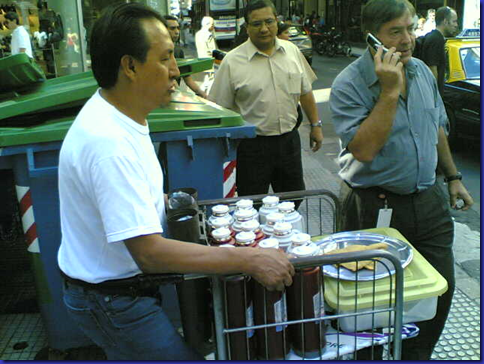
People would stand in there for many hours, so people would get tired, hungry and thirsty. Nothing to do about the first one, but the other two were pretty well covered: there were a few men walking back and forth, offering coffee, sandwiches and some sweet treats, which they had conveniently stored in some tall carts they were carrying around. It wasn't an unusual sight, as you could even see these people walk around downtown Buenos Aires during peak hours, opening the doors to every store to offer their services. It wasn't Tim Hortons, but it was an OK coffee... ;-)
 
image
A ‘cafetero’ – Picture from zexe.net
 
There was another familiar sight in there, and that was the 'canillitas' (literally from Spanish, 'little faucet'), who were selling newspapers and magazines. There were two of them, and they were very careful not to invade each other's territory. The cry would sound the same for both, naming the most important newspapers and then a couple of magazines:
 
- Clarin, Nación, Olé... Gente and Noticias...
 
I smiled when I saw them, as few things are more typically 'porteño' than that (though you will definitely see 'canillitas' in the rest of the country as well). I actually purchased one newspaper ('Olé', I wanted to read about soccer), and was about to focus on my reading when another typical character appeared.
 
It was a 'gestor'. How to translate this word into English without it losing its meaning? Let's see, we could call him a 'facilitator'. It's a gentleman who can alleviate you the pain of going to a place like this and line up for hours only to find out that you forgot to bring that key piece of identification that will make you have to come back again. He will take all of your forms, make sure that you give him all that he will need, and then go through the same workflow you would have had to go, but in 1/10 of the time, because well... he knows somebody in there. Applications must be submitted in person? Not a problem when you're dealing with a 'gestor'. You just get what you need, in time, and for a 'small fee'. Oh, yes, you gotta pay for that... we're not running a charity here, y'know?
 
It was fun to watch this guy cut in the line and go straight to one of the windows, on which he dumped no less than five applications that were processed while this gentleman was talking about soccer with the clerk, whom he obviously knew. Actually, no, it wasn't funny to watch that. You see, this gentleman's job is what in Argentina we would call a 'curro': you get a lot done with little effort, or by knowing the right person, the dream of every Argentine.
 
When I thought that I had seen everything, another typical character showed up: a guy selling ball pens. 1 pen, 1 peso. I was about to laugh when I noticed that this guy was the busiest around, he was selling pens all over the place! "Of course!", I thought, "Everybody needs a pen to fill these long forms, and nobody will go and ask to borrow a pen when you can buy one for a mere $1". I was about to compliment the guy when I noticed that he was selling another article: combs. So you would look good in the passport picture! Unbelievably clever; this is what I Argentina we call a 'busca' (somebody who has an ability to detect what is needed at one place at a specific time, and makes his little personal business around that need).
 
I had a great time at that place, in spite of what happened to me and my paperwork later (I never got my passport and ended at the Brazilian Consulate the following day, so I could get my Canadian passport stamped instead). That same night, I was telling my brother Paco all about this when he suddenly interrupted me:
 
- I'm so dumb! Why didn't I think of this before?
- Think of what?
- You could've 'borrowed' Dad!
(We're half-brothers, but none of us 6 has ever used the word 'half' when referring to each other, as we consider it irrelevant)
- What would I need your dad for? Does he need a new passport too?
- No, jackass! Dad is 72, he's a senior!
- So??!!
- If you go with him, then you don't have to line up!
- But it's me who needs the passport, not him!
- Oh, I see your brain hasn’t fully defrosted yet. It doesn't matter, you're with a senior!
- I cannot believ... wait a second, is that the reason why there were so many elderly people in there today???
- You bet!!
 
I was speechless. There you had it, that was a pure example of a 'curro' and I hadn't noticed it! Retired people get no respect in Argentina, and they are forced to live in really precarious conditions, due to their very low salaries. I wouldn't be surprised at all if I found out that some of them are offering their services as pretend grandpas and grannies, so those with them wouldn't have to wait for hours to be taken care of.
 
All of that for a small fee, of course. :-)
 
 
ArgentinaÚltimamente he estado pensando en mi viaje a Buenos Aires, hace casi un año, con esto de las noticias que están viniendo desde allí (por ejemplo la muerte del ex Presidente Néstor Kirchner). Allí fue que me acordé de que había tomado notas mientras estuve allá, con la idea de que se convirtieran en temas para mis posts. En realidad, escribí un MONTON de notas, pero no creo que todas fueran lo suficientemente buenas. En realidad, me sorprendería si alguna sirviera! :-)
 
Comenzaré por contarles sobre dos o tres personajes con los que me topé mientras hacía la cola para obtener la renovación de mi pasaporte argentino (algo que nunca ocurrió, gracias en gran parte a la burocracia). Creo que ya había escrito sobre el tema, arribé al lugar bien temprano, pero para mi sorpresa ya había un montón de gente. De hecho, la fila que salía desde la oficina de Atención al público era tan larga que salía a la calle y luego daba vuelta a la esquina (dos esquinas!). Yo estimé que la cola tenía al menos 250 m de longitud.
 
La gente permanecía parada allí por horas, así que por supuesto la gente se cansaba, o le agarraba hambre y/o sed. Nada se podía hacer con respecto a lo primero, pero las otras dos cosas estaban muy bien cubiertas: había unos hombres caminando de un lado para el otro ofreciendo café, sándwiches y algunas cosas dulces, las que tenían convenientemente guardadas en unos carritos altos que llevaban. No era una cosa inusual verlos, ya que se los podía encontrar caminando por el centro de Buenos Aires durante las horas pico, abriendo las puertas de los negocios para ofrecer sus servicios. El café no sería como el de Tim Hortons, pero zafaba… ;-)
 
Había otra postal típicamente porteña allí, y se trataba de la presencia de los ‘canillitas’, que vendían diarios y revistas. Habían dos, y se cuidaban muy bien de no invadir el territorio del otro. Ambos voceaban sus productos de la misma manera, nombrando los diarios más importantes y luego un par de revistas:
 
- Clarín, Nación, Olé... Gente y Noticias...
 
Yo sonreí cuando los ví, porque pocas cosas son tan distintivas de los ‘porteños’ como los canillitas (a pesar de que definitivamente se los ve en el interior del país). Compré un diario (‘Olé’, porque quería leer sobre fútbol) y me disponía a leerlo cuando otro personaje típico apareció.
 
image
Picture from Jone’s Flickr
 
Era un ‘gestor’. La traducción de este término al inglés se me hizo dificultosa, y me pregunto si existirá este rol en otros países de la región (calculo que obviamente sí). Se trata, sin dudas, de un señor que lo ‘alivia’ a uno del suplicio de tener que ir a lugares como éste y  hacer kilométricas colas para luego descubrir que uno se olvidó de traer ese papelito que resulta ser indispensable y que lo hará venir de nuevo. El gestor se ocupará de recolectar todos los formularios, se asegurará de que uno le dé todo lo que necesita para hacer el trámite, y luego pasará por las mismas ventanas a las que uno debería haber ido, sólo que en un 1/10 del tiempo, porque bueno… el conoce a alguien en esa dependencia. Los formularios sólo pueden ser entregados en persona? No hay problemas cuando uno lidia con un gestor. Uno va a tener el trámite hecho, terminado en tiempo, y todo por un ‘pequeño monto’. Oh, claro, uno tiene que pagar por eso… o se piensa que yo me dedico a la caridad, che!
 
Fue entretenido ver a este hombre ca**rse en la larga fila que había allí y dirigirse derechito a las ventanillas, en las que depositó no menos de cinco aplicaciones que fueron procesadas ipso facto mientras el empleado y él hablaban de fútbol, como si se conocieran de antes. Bueno, en realidad, no, no fue divertido, daba bronca. Es que no daba la impresión de que este hombre fuera un gestor hecho y derecho, con oficina y esas cosas, sino un tipo que había encontrado lo que en Argentina llamamos un ‘curro’: un trabajo que implica poco esfuerzo y conocer a la persona indicada en cada dependencia oficial, el sueño de todo argentino.
 
Cuando pensaba que ya lo había visto todo, se me apareció otro típico personaje: un hombre vendiendo lapiceras (‘biromes’, como le decimos nosotros). Una birome por un pesito, señor. Ya me estaba por reír por la ocurrencia, cuando caí en la cuenta de que este buen hombre era sin dudas el más ocupado de los vendedores, le pedían biromes de todos lados! “Por supuesto!”, pensé, “Todos necesitan una birome para llenar los formularios, y nadie va a tener la cara de pedir una prestada cuando se la pueden comprar por sólo $1”. Ya lo iba a felicitar al tipo por su visión de negocio cuando noté que vendía también otro artículo: peines. Para asegurarse de lucir bien en la foto del pasaporte! Indudablemente brillante; esto es lo que en Argentina algunos llaman ‘un busca’ (alguien que tiene la habilidad de detectar una necesidad en un lugar y tiempo específico, y se arma un pequeño emprendimiento personal alrededor de esa necesidad).

La pasé muy bien en ese lugar, a pesar de lo que me ocurrió con el trámite (nunca me dieron el pasaporte y terminé en el Consulado de Brasil al día siguiente, para poder lograr que me dieran una visa en mi pasaporte canadiense). Esa misma noche, le contaba todo lo ocurrido a mi hermano Paco, cuando el exclamó de repente:

 
- No se puede ser tan pavo! Cómo no pensé en esto antes?
- Pensar en qué?
- Te lo podrías haber llevado a mi papá!
(Somos medio hermanos en realidad, pero ninguno de los seis ha usado la palabra ‘medio’ para referirse a los demás, porque es irrelevante. Somos todos hermanos).
- Para qué me ibas a ‘prestar’ a tu viejo? Necesita pasaporte también?
- No, pescado.  Papá tiene 72, es un ‘senior’!
- Y??!!
- Que si lo llevás con vos, entonces no tenés que hacer la cola!
- Pero soy yo quien necesita el pasaporte, no él!
- Veo que no se te descongeló el cerebro del todo aún. No importa, estás con un senior!
- No puedo cree… pará un cachito, es por eso que había tantos viejitos en ese lugar?
- Claro!!
 
Me quedé mudo. Ahí tenía el major ejemplo posible de un ‘curro’ y no lo había notado! Los jubilados son muy poco respetados en Argentina, y se ven obligados a vivir en condiciones muy precarias, dados sus bajísimos salarios. No me sorprendería para nada enterarme de que algunos estuvieran ofreciendo sus servicios de abuelos y/o abuelas falsas, para que aquellos que los contrataban no tuvieran que esperar horas para ser atendidos.
 
Todo por un pequeño monto, por supuesto. :-)
 
Technorati Tags:

Monday, August 30, 2010

Gnocchi on the 29th

(En español más abajo)
 
Canada
We went to the pool yesterday (everybody but Santi, who was working) and came back home pretty late. That’s when my mother-in-law reminded us that it was Sunday 29th. Besides being my brother Juan Pablo’s birthday (Happy 26, JP!), it was gnocchi day. You know, those potato dumplings?
 
IMG_1307
Feel free to drool… – Siéntanse libres de babear…
 
Having gnocchi (‘ñoquis’, in Spanish) on the 29th of every month is a very South American tradition, particularly strong among Argentines. There are two different stories that are mentioned as the origin of this tradition (both of which you can find –where else– on Wikipedia). One says that it’s due to a young doctor named Pantaleon, who lived in Asia back in the 8th Century. He converted to Christianity and moved to Italy, where he was responsible for miraculous healings. He was a frugal person, who wouldn’t have any problems eating with the poorest people in the towns he visited. He was eventually canonized and is one of the Patrons of Venice. This happened on July 29th, which is why people honour Saint Pantaleon by having a simple meal (and gnocchi are ideal for that!).
 
IMG_1302
There are virtually no places where we can buy fresh pasta.
We found, however, that store bought gnocchi are pretty good.
No hay casi lugares en donde se puedan conseguir ñoquis fresco.
Hemos comprobado, sin embargo, que los comprados en el super
son buenos. 
 
The other (and much more popular) story behind the gnocchi is related to poor people too. Since the 29th is one of the last days of the month, people who lived in poverty (who would normally get paid on the 1st) wouldn’t have a lot of money left for food. That is why they would prepare what in Argentina is known as “ñoqui de pobre” (“Poor people’s gnocchi”), made with flour, eggs and/or water (without even using potatoes).
 
In both cases, the tradition includes putting some money under the plate before being served, as a way to invoke luck and prosperity. Though I know it is a widespread practice, I don’t remember anybody in my family having done it.
 
IMG_1306
Careful, Gaby! – Cuidado, Gaby! 
 
The last story behind the gnocchi is related to Argentine politics and –of course– corruption. For ages, but particularly since we went back to democratic governments in 1983, it has been a practice for entry-level politicians to ‘hire’ a big number of ‘assistants’ in all kinds of different areas (most notable in both sides of the Congress, Ministries and the Local Legislative Power). This people (either relatives or people affiliated to the same political party as the corrupt politicians mentioned before), would receive a salary without even having to go to work, as long as they were willing to share with their ‘boss’. So, all they would have to do was to show up at the end of the month (normally, on the 29th) to get their paycheques. I wish I could say this doesn’t happen anymore…
 
Since these people would never be seen around the workplace except for payment day, they received the unfortunate nickname of ‘gnocchi’. You would only see them on the 29th…
 
But that’s not our case. We just enjoy to eat them, whether it’s the 29th of the month or not.
 
Believe me, I do work for a living.
 
 
ArgentinaAyer fuimos a la pileta (excepto Santi que tuvo que trabajar) y volvimos a casa muy tarde. Allí fue que mi suegra nos recordó que era domingo 29. Además de ser el cumple de mi hermano Juan Pablo (Felices 26, JP!), era día de ñoquis!
 
IMG_1310
With just cream and butter, a favourite among our kids
Sólo con crema y manteca, la versión preferida por mis hijos
 
Comer ñoquis los 29 de cada mes es una tradición muy sudamericana, particularmente fuerte entre los argentinos. Hay dos distintas teorías sobre cómo se originó esta tradición (las cuales obtuve –por supuesto– en Wikipedia). Una dice que se debe a un joven médico llamado Pantaleón, quien vivió en Asia Mayor en el Siglo VIII. El se convirtió al cristianismo y peregrinó por Italia, donde fue responsable por curaciones milagrosas. Era una persona muy frugal, que no tenía problemas en sentarse a comer con la gente más pobre de los pueblos que visitaba. Eventualmente fue canonizado y es hoy uno de los Patrones de la ciudad de Venecia. Esto ocurrió un 29 de Julio, y la gente honra a San Pantaleón con una comida muy simple (y qué mejor que los ñoquis!).
 
La otra (y mucho más arraigada) historia sobre el origen de esta pasta también se relaciona a la gente pobre. Como el 29 es uno de los últimos días del mes, la gente pobre (que normalmente cobraba los dias primero) ya no tenía casi dinero para comer. Por eso es que preparaban lo que en Argentina es llamado “ñoqui de pobre”, hechos con harina, huevos y/o agua (sin siquiera usar papas).
 
IMG_1303 You put them on a pot with boiling water.
Once they come to the top, they’re ready.
Los ponen en una olla con agua hirviendo.
Cuando suben, ya están listos!
 
En ambos casos la tradición incluye el poner dinero debajo del plato antes de ser servido, para atraer la suerte y la prosperidad. Si bien sé que es una práctica muy común, yo no recuerdo que nadie en mi familia lo haya hecho.
 
La última historia sobre ñoquis se relaciona con la política argentina y –por supuesto– la corrupción. Por décadas, pero particularmente desde el retorno a la democracia en 1983, ha sido una práctica constante entre políticos de escaso o limitado vuelo la de ‘contratar’ a un gran número de ‘asesores’ en todo tipo de áreas (algo muy común en ambas cámaras del Congreso, los ministerios o las legislaturas locales). Esta gente (ya sea parientes o afiliados adictos del mismo partido que los políticos que mencioné), reciben un sueldo sin tener que ‘molestarse’ en ir a trabajar, mientras estén dispuestos a compartir una parte del mismo con su ‘jefe’. Debido a esto, todo lo que tienen que hacer es aparecer por el lugar de trabajo a fin de mes, por lo general el 29 y levantar su recibo de sueldo. Cómo me gustaría decir que esto ya no ocurre más…
 
IMG_1313
Yes, Florencia, they were that good! – Sí, Flor, estaban así de ricos!
 
Como a esta gente los empleados honestos no los veían nunca excepto en el día de pago, recibieron –con justicia– el apodo de ‘ñoquis’. Sólo aparecían una vez por mes, los 29…
 
Ese no es nuestro caso, por supuesto! A nosotros nos gusta comer ñoquis, sea el 29 del mes o no.
 
Yo trabajo, créanme.
 
Technorati Tags: ,,

Monday, September 21, 2009

Coming soon to LfW… Argentine memories

CanadaI’m always thinking of what I could write about next… which causes me never to finish the series I’m currently writing! So, ever since I do something to follow up my ‘Soitenly!’ series, I won’t start until I write the three missing episodes.
 
But once I do, I will go for what’s probably my biggest challenge so far: write about those things I love as a kid, a teenager and an adult… only that they all will be from Argentina. I will write about TV shows, magazines, comic strips… etc. So the challenge is the obvious: how to make that interesting to my non-Spanish speaking readers? Well, I will find the way. For example, I’m working on subtitles for all the videos I will feature here…
 
If you’re Argentine, you will probably like this list. If you’re not, I hope you still find it interesting. Below are some I am planning to write about…
 
Argentine readers, you think I’m missing any? Let’s keep in mind that I’m talking about Argentine icons, mostly from the 70’s… and that this is G-rated blog. :-)
 
 
Argentina
Siempre estoy pensando en que voy a escribir más adelante… lo que cause que nunca termine las series que estoy escribiendo ahora! Por eso, y si bien ya tengo con qué seguir mi serie ‘Soitenly!’, no lo haré hasta que no termine con los episodios que me faltan.
 
Pero una vez que lo haga, voy a comenzar lo que probablemente sea mi más grande desafío hasta ahora: escribir sobre las cosas que yo amaba de chico, y  que aún disfruto como adulto. Escribiré acerca de shows de TV, revistas, historietas… etc. Así que el desafío es: cómo hacer esto interesante, especialmente para mis lectores que no hablen español? Bueno, ya encontraré la vuelta. Por ejemplo, estoy trabajando en los subtítulos para los videos que voy a mostrar aquí…
 
Si Uds. son de Argentina, posiblemente les guste esta lista. Si no lo son, espero que aún lo encuentren entretenido. Aquí abajo hay algunos de los episodios que tengo planeados…
 
Lectores latinos, piensan que me olvido de alguien? Recuerden que voy a hablar acerca de íconos de Argentina, mayormente de los 70’s… y que sean aptos para todo público (así que no hay lugar para Porcel o Isabel Sarli). :-)
 
 
Pepe Biondi
José ‘Pepe’ Biondi (the best –and funniest– Argentine TV comedian ever, period)

José ‘Pepe’ Biondi (el mejor cómico argentino de la historia, en mi opinión)

image

Mafalda (the most famous Argentine comic strip, created by that marvel that is Quino)

Mafalda (la historieta argentina más famosa, creada por el genial Quino)
image

Les Luthiers (the incredibly talented and no less funny Argentine musical group; 40 years performing at the highest level, and with those instruments!)

Les Luthiers (el increíblemente talentoso y divertido grupo musical; más de 40 años en el más alto nivel, y con qué instrumentos!)
image

Luis Landriscina (a fantastic story teller, he makes you laugh and learn about our people traditions at the same time)

Luis Landriscina (fantástico narrador de divertidas historias de nuestro terruño)
image

Hijitus (the very first Argentine TV cartoon – or at least the most popular)

Hijitus (el personaje de TV más famoso para nosotros los que tenemos un poquito más de 40)
image

Clemente (very well know comic strip by Caloi, that also had a stint on TV)

Clemente (la muy conocida historieta de Caloi, que tuvo un paso fugaz por la TV)
image

María Elena Walsh (the brilliant author and singer, mostly dedicated to kids)

María Elena Walsh (la brillante cantautora argentina)
image

Billiken magazine (many, many years of great comic strips and lots of material for school)

Revista Billiken (muchos, muchos años de geniales historietas y material para la escuela)
image

Carlitos Bala (the greatest ever comedian and singer dedicated to kids)

Carlitos Bala (el genial artista y conductor de espectáculos para chicos)
 
 
Technorati Tags:
Related Posts Plugin for WordPress, Blogger...

Buy at KW Empanadas!

Share |